Showing posts with label Amalfi Coast. Show all posts

Thursday, July 9, 2015

Pompeii & Mt. Vesuvius

Guest Blogger: Michael Mammele 

In Southern Italy there are countless things to do and experiences to be had. I’ve been lucky enough to live along the Amalfi Coast for the past month and a half but recently, I was able to travel farther inland to two sights that are rich in history: the ruins of Pompeii and Mt. Vesuvius. I embarked on a bus with a group of about 50 people from Amalfi and began the journey to Pompeii.

Pompeii is now ruins of an ancient Roman city that experienced the devastating eruption of Mt. Vesuvius in the year 79AD. The eruption killed over 3,000 people, while over 20,000 fled the city entirely. Upon arriving I was immediately blown away by the vast architecture. It made me think about how incredible it is that nearly 2000 years ago, a structured civilization was able to create such a breathtaking city. The ruins themselves are much like an outdoor museum. Our tour group walked through old palaces, thermal spas, and looked at ancient paintings frozen in time. We walked through the famous amphitheater, completed in 80BC. This site was home to numerous spectacles and gladiator battles. I grew up watching the movie “Gladiator” with Russell Crowe and here I was literally standing on the very grounds that partly inspired the film.


We looked into small cement rooms where the gladiators, who were prisoners, slept. The rooms were no bigger than the average home bathroom; most of them had no roof to protect from rain. Not only was I in amazement at the historical sights I was seeing but I was humbled in the process.


While I loved Pompeii and the ruins, I couldn't wait to start the second half of the day: the climb of Mt. Vesuvius. The bus ride took about 45 minutes from Pompeii and pulled nearly to the top of the mountain, where the group disembarked and climbed the rest of the way. Standing at the top of a volcano was always something I considered to be a “bucket-list” activity, and not a very realistic one at that. Yet, here I stood well over 3000 feet in the air, staring into this massive crater. In fact, massive doesn't even do the size of this beauty justice.


I was surrounded with a jaw-dropping panoramic view over the city of Naples, the Bay of Salerno, and the islands of Capri and Ischia. I could see smoke slowly protruding from the bottom of the crater. I had to pinch myself to realize that I wasn’t dreaming. It was a day that I’m certain I will never forget.

While I met some great people from all over the world, I was truly happy to spend a day by myself and experience a real adventure. While traveling with companions is always pleasant, I think everyone should travel to at least one destination by themselves; it clears your head and gives you a great sense of independence. I couldn't have been happier with how the day turned out, and can't wait for my next adventure.


Sunday, May 17, 2015

Sunday Dinner

Guest Post By: Michael Mammele

Today I experienced my first Sunday dinner in Italy, and it was one that I'm sure I will never forget. I knew that I was in for an immersing experience, being the only person at the table that could barely speak a word of Italian. Luckily with Valeria by my side as my personal translator, I was able to share the laughs and good spirits of the great company I was with, truly making me feel like I was family. 

The meal started with the “antipasto” portion; something to nibble on before the larger portions arrived. This consisted of fried dough balls stuffed with pancetta. It was unbelievable and left me curious as to know what was up next. 

Next up was the “primo,” or the appetizer portion. It consisted of crepes with ricotta cheese and cream sauce, as well as lasagna with meat sauce. I would not consider myself a picky eater, but at home I know what I like and what I do not. Usually I would take a bite or two of something unfamiliar and pretend that I enjoy it not to upset whoever was cooking. Today, however, I knew I better not let a crumb go to waste. The crepes were truly out of this world, and the cream sauce that came along with it added so much to each bite. The lasagna was the best I've had. I felt myself getting full already, not even realizing that there were three more courses to come. 

The second course is referred to as "the secondo," and consisted of meatballs, and chicken and veal cutlet. The food was non-stop. Once I finished each plate Francesco's mother Esther was right there with the next. I know better than to say anyone's meatballs are better than my own mother's, but these were absolutely incredible. 

The “contorno” is the fourth dish, translating loosely to the word, "contours," meaning vegetables that help shape the entire meal. It was a delicious salad with lemon, olive oil, and salt; relatively simple, and a great way to help wind down the experience. 

At last was the “dolce,” or dessert. Just take a look for yourself.


While the meal was unbelievable, what made this dinner an experience was the people I was with. Conversation was constant, everybody took a turn to pour some Ferrarelle (Italian sparkling water) and soccer was on the television. While I may not speak Italian, I didn't need to to feel like I was part of this family. The first thing Francesco's father said to me was to move my chair in closer to the table, making sure I was involved. Out of all the ingredients put into this exceptional meal, the most prominent one was clearly family. 

Today, I was most certainly family. 


Tuesday, January 20, 2015

Positano Bites Deep

I happened to find the article written on Positano by John Steinbeck (published in Harper's Bazaar in 1953) while he was visiting the Amalfi Coast. It is published on the historic hotel Le Sirenuse's website so I thought it would be nice to share with you. It is a lovely essay and those of you who know Positano will smile with it's words. I suggest taking a moment to read it.


POSITANO BY JOHN STEINBECK

I first heard of Positano from Alberto Moravia. It was very hot in Rome. He said, “Why don’t you go down to Positano on the Amalfi Coast? It is one of the fine places of Italy”. Later John McKnight of United States Information Service told me the same thing. He had spent a year there working on a book. Half a dozen people echoed this. Positano kind of moved in on us and we found ourselves driving down to Naples on our way.
To an American, Italian traffic is at first just down-right nonsense. It seems hysterical, it follows no rule. You cannot figure what the driver ahead or behind or beside you is going to do next and he usually does it. But there are other hazards besides the driving technique.

There are the motor scooters, thousands of them, which buzz at you like mosquitoes. There is a tiny little automobile called “Topolino” or “mouse” which hides in front of larger cars; there are gigantic trucks and tanks in which most of Italy’s goods are moved; and finally there are assorted livestock, hay wagons, bicycles, lone horses and mules out for a stroll, and to top it all there are the pedestrians who walk blissfully on the highways never looking about. To give this madness more color, everyone blows the horn all the time. This deafening, screaming, milling, tire-screeching mess is ordinary Italian highway traffic. My drive from Venice to Rome had given me a horror of it amounting to cowardice.

I hired a driver to take me to Positano. He was a registered driver in good standing. His card reads: “Signor Bassani Bassano, Experienced Guide – all Italy – and Throt Europe”. It was the “Throt Europe” that won me.
Well, we had accomplished one thing. We had imported a little piece of Italian traffic right into our own front seat. Signor Bassani was a remarkable man. He was capable of driving at a hundred kilometers an hour, blowing the horn, screeching the brakes, driving mules up trees, and at the same time turning around in the seat and using both hands to gesture, describing in loud tones the beauties and antiquities of Italy and Throt Europe. It was amazing. It damn near killed us. And in spite of that he never hit anybody or anything. The only casualties were our quivering, bleeding nerves. I want to recommend Signor Bassani to travelers. You may not hear much of what he tells you but you will not be bored.

We squirmed and twisted through Naples, past Pompei, whirled and flashed into the mountains behind Sorrento. We hummed “Come back to Sorrento” dismally. We did not believe we could get back to Sorrento. Flaming like a meteor we hit the coast, a road, high, high above the blue sea, that hooked and corkscrewed on the edge of nothing, a road carefully designed to be a little narrower than two cars side by side. And on this road, the buses, the trucks, the motor scooters and the assorted livestock. We didn’t see much of the road. In the back seat my wife and I lay clutched in each other’s arms, weeping hysterically, while in the front seat Signor Bassano gestured with both hands and happily instructed us: “Ina dda terd sieglo da Hamperor Hamgousternos coming tru wit Leegeceons”. (Our car hit and killed a chicken.) “Izz molto lot old heestory here.

page2image376
I know. I tall.” Thus he whirled us “Throt Italy”. And below us, and it seemed sometimes under us, a thousand feet below lay the blue Tyrrhenian licking its lips for us. Once during the war I came up this same lovely coast in the American destroyer Knight. We came fast. Germans threw shells at us from the hills and aircrafts splashed bombs at us and submarines unknown tried to lay torpedoes on us. I swear I think it was much safer than that drive with Signor Bassano. And yet he brought us at last, safe but limp, to Positano.

Positano bites deep. It is a dream place that isn’t quite real when you are there and becomes beckoningly real after you have gone. Its houses climb a hill so steep it would be a cliff except that stairs are cut in it. I believe that whereas most house foundations are vertical, in Positano they are horizontal. The small curving bay of unbelievably blue and green water laps gently on a beach of small pebbles. There is only one narrow street and it does not come down to the water. Everything else is stairs, some of them as steep as ladders. You do not walk to visit a friend, you either climb or slide.

Nearly always when you find a place as beautiful as Positano, your impulse is to conceal it. You think, “If I tell, it will be crowded with tourists and they will ruin it, turn it into a honky-tonk and then the local people will get touristy and there’s your lovely place gone to hell”. There isn’t the slightest chance of this in Positano. In the first place there is no room. There are about two thousand inhabitants in Positano and there is room for about five hundred visitors, no more. The cliffs are all taken. Except for the half ruinous houses very high up, all space is utilized. And the Positanese invariably refuse to sell. They are curious people. I will go into that later.

Again, Positano is never likely to attract the organdie-and-white linen tourist. It would be impossible to dress as a languid tourist-lady-crisp, cool white dress, sandals as white and light as little clouds, picture hat of arrogant nonsense, and one red rose held in a listless white-gloved pinky. I dare any dame to dress like this and climb the Positano stairs for a cocktail. She will arrive looking like a washcloth at a boys’ camp. There is no way for her to get anywhere except by climbing. The third deterrent to a great influx of tourists lies in the nature of the Positanese themselves. They just don’t give a damn. They have been living here since before recorded history and they don’t intend to change now. They don’t have much but they like what they have and will not move over for a buck.
We went to the Sirenuse, an old family house converted into a first class hotel, spotless and cool, with grape arbors over its outside dining rooms. Every room has its little balcony and looks out over the blue sea to the islands of the sirens from which those ladies sang so sweetly. The owner of the Hotel Sirenuse is an Italian nobleman, Marquis Paolo Sersale. He is also the mayor of Positano, a strong handsome man of about fifty who dresses mostly like a beachcomber and works very hard at his job as mayor. How he got the job is an amusing story.

Positano elects a town council of fifteen members. The council then elects one of its members mayor. The people of Positano are almost to a man royalist in their politics. This is largely true of much of the South of Italy but it is vastly true of Positano. The fishermen and shoemakers, the carpenters and truck drivers favor a king and particularly a king from the house of Savoy. This was true when the present mayor was elected. The Marquis Paolo Sersale was elected because he was a Communist, the only one in town. It was his distinction in a whole electorate of royalists. One of Sersale’s ancestors commanded a gallery of war at the Battle of Lepanto in 1571 when the power of the Moslem was finally broken and Christian control of Europe assured. He does not say why he became a Communist. But he does say that he left the party in 1947 not in anger but in a kind of disgust. The township was a little sad about his losing his distinction, but they have elected him ever since, in spite of that.

page3image376
The mayor of Positano is an archaeologist, a philosopher and an administrator. He has one policeman to keep order and there isn’t much for his force to do. He says, “Nearly all Positanese are related. If there is any trouble it is like a family fight and I never knew any good to come of interfering in a family quarrel”. The mayor wanders about the town upstairs and downstairs. He dresses in tired slacks, a sweat shirt and sandals. He holds court anywhere he is, sitting on a stonewall overlooking the sea, leaning against the edge of a bar, swimming in the sea or curled up on the beach. Very little business gets done in the City Hall. The police force has so much time free that he takes odd jobs to make a little extra money.

The history of Positano is rich, long and little crazy. But one thing is certain: it has been around a long time. When the Emperor Tiberius moved to Capri because he was detested in Rome, he didn’t trust anyone. He thought people were trying to poison him, and he was probably right. He would not eat bread made with the flour of his part of the country. His galley instead crept down the coast to Positano and got flour from a mill which still stands against the mountain side. This mill has been improved and kept up, of course, but it still grinds flour for the Positanese.
This little town of Positano has had a remarkable past. As part of the Republic of Amalfi in the ninth, tenth and eleventh centuries, it helped to write the first maritime laws we know in which the rights of sailors were set down. In the tenth century it was one of the most important mercantile cities of the world, rivaling Venice. Having no harbor, its great galleys were pulled bodily up on the beach by the townspeople.

There is a story that on one Holy Saturday when no church bell was allowed to ring in all Christendom, a Positano ship was in trouble from a great storm. The bishop who was officiating at the altar declared the rule off, rang the bell himself and then joined the population on the beach and in his vestments helped to pull the crippled ship ashore.
Like most Italian towns Positano has its miraculous picture. It is a Byzantine representation of the Virgin Mary. Once, long ago, the story goes, the Saracenic pirates raided the town and among other things carried away this picture. But they had no sooner put to sea when a vision came to them which so stunned them that they returned the picture. Every year on August 15, this incident is re-enacted with great fury and some bloodshed. In the night the half-naked pirates attack the town which is defended by Positanese men-at-arms dressed in armor. Some of this fighting gets pretty serious. The pirates then go to the church and carry the holy picture off into the night. Now comes the big moment. As soon as they have disappeared into the darkness, a bright and flaming image of an angel appears in the sky. At present General Mark Clark is the sponsor of this miracle. He gave the town a surplus Air Force barrage balloon. Then very soon the pirates return in their boats and restore the picture to the church and everybody marches and sings and has a good time.

In the sixteenth and seventeenth centuries Positano became very rich. Its ships went everywhere, trading in the Near and Middle East, carrying the spices and precious wood the Western world craved. Then the large and beautiful baroque houses that stand against the mountain were built and decorated with the loot of the world.
About a hundred years ago a tragedy came to the town. Steamships began to ply the ocean. Positano could not compete; year by year it grew poorer and more desperate. At that time there were about eight thousand citizens. Between 1860 and 1870 about six thousand of the towns-men emigrated to America and great houses stood vacant and their walls crumbled and the painted designs paled out and the roofs fell in. The population has never got much above two thousand since. If Positano bites deeply into a stranger, it is branded on the Positanese. The bulk of the émigrés went to New York and most of them settled on Columbus Avenue. They made a little Positano of it, they celebrate the same festivals as the mother town, they talk Positano and live Positano. In New York there are over five
page4image400
thousand people who were born in Positano – twice as many as live in the mother city. Besides these there are many thousands of descendants and all of them are tied very closely to the Italian city.

One of the hardest duties of the mayor is trying to find graveyard space for the New York Positanese who want their bodies returned to their native town. The graveyard is as big as it can be. There is no room to extend it without blasting away the mountain. Just about every available inch is taken, but the mayor must edge the old-timers in some way.

About ten years ago a Moslem came to Positano, liked it and settled. For a time he was self-supporting but gradually he ran out of assets and still he stayed. The town supported him and took care of him. Just as the mayor was their only Communist, this was their only Moslem. They felt that he belonged to them. Finally he died and his only request was that he might be buried with his feet toward Mecca. And this, so Positano thought, was done. The Moslem had been buried by dead reckoning and either the compass was off or the map was faulty. He had been buried 28 degrees off course. This was outrageous to a seafaring town. The whole population gathered, dug the Moslem up, put him on course and covered him up again.

Positano does not have much of any industry. At night the fishing boats put out with powerful lights on their bows. They fish all night for anchovies and squids, and the bow lights of the boats litter the sea to sight’s edge. But in fishing, Positano has a rival – the little town of Praiano, a few miles down the coast. The rivalry has been so great that a fishing code has been long established. When a school of fish is sighted the lampara boats run for it. The first boat to reach it puts out its net and make its circling run. Meanwhile other boats from the other town have raced for the school. If the first boat completes its circle before the others arrive, the school belongs to it. If not, both the towns share in the catch. This is important in light of a story that comes later.

On shore there is a little shoemaking, some carpentry and a few arts and crafts. It would be difficult to consider tourists an industry because there are not enough of them. They do, however, provide a bit of luxury for the villagers.

Far up the mountain a convent looks down on the sea and here little girls are taught the delicate and dying art of lacemaking by the sisters. The girls are paid and the lace sold to support the school and incidentally the children. The flying fingers of the little girls working with the hundreds of bobbins make the eye dizzy, and the children look up and laugh and talk as though they were not even aware of the magic of their flashing fingers. Some of the work is unbelievable. We saw a great tablecloth, a spider web intricate as a thought. It was the work of fifty for one year.
In a few days we became aware of Positano’ s greatest commodity – characters. Maybe they aren’t marketable, but Positano has them above every community I have ever seen. There are the men who have lived in America and have come again to bask in the moral, physical, political and sartorial freedoms which flourish in their birth town. Clothing is as harum- scarum as a man’s mind can wish, but it must be comfortable. The postman who climbs all stairs every day wears his official postman’s cap and corduroy trousers with braces but has left off a shirt if the day is warm. An other man finds pajama pants, a loose vest and a flat straw hat the perfect costume. He carries sandals but in the same way a well dressed man who hates gloves carries gloves. Even the lightest open sandal is a stricture on his happy feet.

In a bar or on the beach you may see an incredibly old man with the bright eyes of a wise bird or an innocent snake. He is a witch. He learned his craft from a witch. He treats the ills of the whole town. His method lies in his hands, small, white, weak-looking hands. When a patient has pain, these hands slowly creep over the area while the eyes of the wizard look off into space and he seems to be listening. The hands seems to be
page5image376
separate from him. The fingers find the area of pain and then gently walk about it, feeling and soothing and massaging but very gently. And his patients say that the pains go away. I don’t know. I didn’t have any pain.
Yes, Positano flourishes with characters. On the beach there is a famous shoemaker. He builds sandals and shoes for the whole town, but this is only his part-time job. He believes that Ferragamo, the great Italian shoe designer, steals his ideas and he is a little angry about it, but then he realizes his true role. He is the friend and confident of great men. Once a number of years ago, he was the eyes and, some say, the conscience of Dino Grandi, the Italian general. When Grandi came to Positano to rest he sometimes sat and talked with the shoemaker. And after the general had left, the shoemaker would not talk to common mortals for several days. He tapped and thought and sewed and thought and he remarked once: “I do not feel it fitting that I should discuss anything with outsiders after I have been admitted to the secrets of government and diplomacy”. He got to talking like Grandi and standing with his head back and his chin out the way Grandi did.

After the war, General Mark Clark came to Positano and he too talked with the shoemaker. And again the shoemaker would not speak for several days, but it was noticed that he stood with his shoulders forward and his head bent studying the ground – the normal posture of General Clark. The shoemaker told me in some confidence: “He put his hand right here, right here, the General did,” and he pointed to a place on his shoulder, and his eyes looked off into grandeur.

Mark Clark has left his mark on the town. In an older time he would wear the halo of a saint instead of the stars of a general. He is the town’s patron and he rose to this position rather simply. Positano has always had a temperamental and highly undependable water system. There is plenty of water in the mountain but the means to get it to the gardens and the kitchens of the town were primitive or nonexistent. Mark Clark gave the town a few thousand meters of scrap water pipe, left over from the Italian campaign. The townsmen installed it themselves. Now the water goes inevitably to the gardens and the kitchens and the public fountains of Positano, so that many times a day every Positanese thinks of the General Mark Clark, pronounced Clock.

A number of writers have gone to Positano to do their work. Some of these are Americans and some are British. Nothing in the little town is designed to disturb your thoughts provided you have a thought. Such a recluse was John McKnight, now of the United States Foreign Service, but then in process of writing The Papacy, a long and careful study of the history of the Vatican and its position in the present-day world. He and his wife lived for a year in a little house with a garden right over the water in the southern part of the town. The McKnights come from North Carolina and they settled into the life of Positano as naturally as they had settled into Chapel Hill. Then the year turned and Thanksgiving began looming.

Now an American living long abroad may become completely expatriate. He may speak foreign, think foreign, eat foreign, but let Christmas or Fourth of July or Thanksgiving come around and something begins to squirm inside him and he finds he has to do something about it. Johnny and Liz McKnight speak Italian fluently, read, eat and live Italian. But when Thanksgiving came near in Positano, the McKnights found themselves dreaming of roast turkey and dressing, of cranberry sauce and plum pudding, of mint juleps. They got to waking up in the night and thinking about it.

The turkey arrived in a crate tied to the top of a bus. It was a fine vigorous but slightly hysterical bird and for a week it gobbled and strutted in the one bird turkey yard built for it in the garden until gradually its nerves got back to normal. It didn’t know that the looks of its new friends were not friendly.

page6image384
Johnny remembered a bit of wisdom imparted to him by his grandfather, in North Carolina. Violent death, his grandfather said, be it to man or to turkey, is a nervous and discouraging experience. The muscles are likely to go hard and certain unhappy juices are released into the system. His grandfather did not know how that affected the flavor of man but in a turkey it had a tendency to make the meat tough and a little bitter. But there was a way to avoid that. If about two hours before the execution, the turkey is given a couple of slugs of good brandy, the nervous tension relaxed, the turkey’s state of mind is clear and healthy and he goes to the block happy and even grateful. Then when he is served, instead of bitter juices of fear and shock, there is likely to be a delicious hint of cognac in the meat.

Johnny decided to follow the custom of North Carolina. Then he found that he did not have brandy. The bourbon he had provided for juleps did not seem right and the only other thing he had was a bottle of Grand Marnier. It was better than brandy. It would give not solace to the turkey but an orangey flavor to the meat.

The turkey fought the idea at first. But finally Johnny got him held firmly under his arm and held the beak open while Liz put four or five eyedroppers of Grand Marnier down the bird’s throat. At first the turkey gagged a little but in a moment or two its head dropped, a sweet but wild look came in its eyes and it waved its head in rhythm with some gentle but not quite sober thought that went through its head. Johnny carried it gently to the pen. It wobbled a bit and settled down comfortably and went to sleep. “I’ll do for it in its sleep”, Johnny thought. “That turkey will never know what happened”. And he went to the refrigerator to see how the mint juleps were doing.

They were doing fine. He brought two of them back to the garden, and he and Liz sat down to begin the Thanksgiving. The McKnights do not know what happened. Johnny thinks the turkey may have had a bad dream. They heard a hiccupping gobble. The turkey rose straight up in the air, and screaming triumphantly flew out to the sea. Now we must go back to the sea laws of the Amalfi Coast. In the hills above the towns of Positano and its rival Praiano, wFatchers are usually posted. They not only keep watch for schools of fish but for anything which may be considered flotsam, jetsam or salvage. These watchers saw the McKnights’ seagoing turkey fly to sea and they also saw it crash into the water a couple of miles off shore.

Immediately boats put off from both Positano and Praiano. The race was on and they arrived at about the same time. But the turkey, alas, had drowned. The fishermen brought it tenderly back, arguing softly about whether it was a matter for salvage court. The turkey was obviously out of command. Johnny McKnight easily settled the problem with the rest of the bottle of Grand Marnier.

They cooked the turkey that afternoon and sat down to dinner about eight in the evening. And they say that not even an extra dose of sage in the dressing completely removed the taste of sea water from the white meat.
(from Harper’s Bazaar, May 1953) 

Monday, January 19, 2015

What Happens in Italy...


The best things in life are not things at all. They are experiences. 

Share your amore for Italy and come spend the day with Exclusive Cruises. It's guaranteed to be a good time, just watch the above video and you will see...


Friday, April 11, 2014

Earth Day on the Amalfi Coast

With Earth Day approaching, all of us here at Exclusive Cruises are taking the time to reflect on what the environment means to us and what we can each do to maintain it.

The Amalfi Coast is famous for it’s spectacular views, the beautiful Mediterranean Sea, the fresh food produced here and the warm sunshine. These are all natural things- part of the earth, and it is our job to maintain them to the highest degree possible.

Everyone who lives on the Amalfi Coast, Capri, Ischia and the surrounding areas is dependent on the land for survival. The lemons that are grown to make our delicious granitas, the olives used for our fresh olive oil, the grapes grown to produce our local wines…the tomatoes, the fish in the sea…I could go on and on.

Not only is it important to maintain the natural beauty for the tourists who keep the local economy strong, but for the people who live here, who wake up every morning to the beautiful Mediterranean sunshine…the people who help make this beautiful region so special.

This year, Exclusive Cruises is asking for everyone on April 22, 2014 (EARTH DAY!) to give back to the community.  

Below are some ideas:

11.  Pick up trash that you see discarded on the ground or in the sea, even if it is not your trash!
22. Shut off the lights when you leave a room
33. Carpool or take a bike or the bus
44. Create a group of friends to donate a few hours to cleaning up the towns and villages together
55. TEACH and EDUCATE your children the importance of keeping the environment clean!!!
L6. Let’s make every day Earth Day!

 
View of Positano 
View of Atrani from Amalfi

Saturday, November 2, 2013

Thermal Hot Springs- The island of Ischia and Poseidon Gardens

Incorporate this experience into a Wellness Tour on the island of Ischia with Exclusive Cruises

One of the most fabulous things to do while visiting the island of Ischia is to experience the thermal spas. Ischia is a volcanic island that sits off the coast of Naples and is home to about 60,000 inhabitants.
Known for its natural thermal hot springs, people from all over the world go with the hopes of healing an ailment, or just for some R&R.
Last week I chartered the Rio Blu 32 yacht from Amalfi to Ischia with clients and I decided to stay for the night and explore the island. The next day I found myself at Poseidon Thermal Gardens, the largest thermal park on the island, boasting 22 pools ranging from ice cold to extremely hot. The experience was extraordinary to say the least.
I started in the morning, beginning with the large 36 degree pool and went “pool hopping” from there. Many of the pools have waterfalls and massage jets which was absolute heaven.
 There is also a wonderful little pool with shallow water and a pebble bottom, where I walked on the pebbles through hot and then cold water….a natural massage therapy for my feet!

 Other pools are divided into two sections where I submerged my body into the hot water, then alternated with ice cold water. Although it was tough to walk all the way into the ice pool, it was well worth it in the end because my pores were invigorated and the feeling was exhilarating.
After making all of the rounds I decided to go down for a healthy lunch-tuna and vegetable salad. After lunch, I wanted to digest before heading back to the thermal pools, so  I went to relax under the sun, as Poseidon has it’s own private area of Citara beach, sitting on a beautiful little bay and full of sun beds and straw umbrellas.
The pools are outdoors on various levels, some cut into rocks and some on ledges. Overlooking the sea and Citara Beach, it is beautiful.
                               (Notice the steam from the springs creeping into the right side of the photo!)

The park has lush gardens, a shopping boutique, an indoor wellness center with various massage techniques that can be purchased separately, a salt water pool, a cave sauna and more.
 It was a fun, relaxing and healthy experience.
There are countless theories regarding the benefits of natural thermal hot springs and I plan on returning as often as possible, especially because it is easy to arrive on the boat from Naples, Capri or the Amalfi/Sorrento Coast. Contact us for details on a Wellness Tour.
 exclusivecruisesitaly@gmail.com


Sunday, May 19, 2013

From Skyscrapers to Lemon Groves – Part 1


Daily Life on the Amalfi Coast

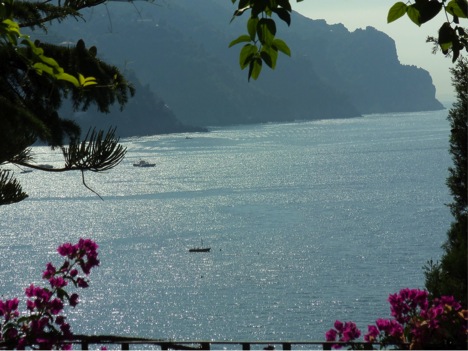
I took this picture in early morning on my daily walk - when the Amalfi coast was just waking up
Daily life on the Amalfi Coast is full of sunshine, garlic and lemons. Riding a Vespa along the famous Amalfi Drive, curving between the cliffs and the sea, I look at the view and wonder what I did to deserve living in such a breathtaking place.
You can tune in to my short video series documenting my daily life here, but in the meantime I will tell you a little about my latest adventures.
The Amalfi Coast is composed of a variety of small towns just south of Naples on the Mediterranean coast. Houses are built into the rocks and cliffs overlooking the sea. Lemon groves and grape vines are scattered through the winding roads. Life is simple here and revolves mostly around family. Every day for lunch, families join and sit for a meal of pasta and wine, followed by seasonal fruit and an espresso. Then a swim is usually in line before getting back to work. Everyone has a tanned glow and is smiling, offering some sort of food or beverage, using loud voice inflections in both Italian and Neapolitan dialect accompanied animated hand gestures. 
My main source of transportation here is hitching a ride, or “prendere un passagio”. Since the coast is so small, I more than often know someone passing. I usually jump on the back of a vespa and ride from one town to the next, visiting family, friends, or discovering new beach.

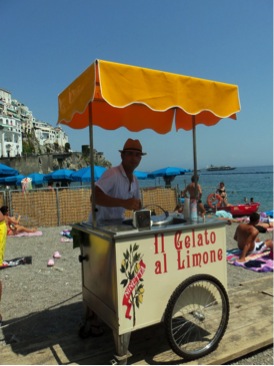
Andrea with his Granita Cart on the beach in Amalfi

The economy here thrives on tourism. The economic crisis hit the coast like a ton of bricks, but it is slowly recovering. This year my cousin Andrea (Andrew in English) started a new business making lemon slushies (or granitas), from a small cart. The lemons are of course grown locally and organically and his granitas are the best on the coast (I’m not biased). It makes me laugh to see him rolling by along the beach or the port with his cart, and he has an equally fun personality to accompany it.
The beaches offer sunbed and umbrella rentals, restaurants cook recipes with fresh fish caught daily, handmade pasta, and locally grown vegetables and fruit. Hotels include terraces overlooking the sea and the shops sell handmade ceramics, unique to the coast.


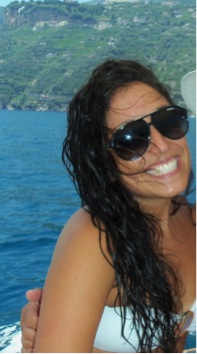
Me! Boating on the Mediterranean Sea
Sometimes I feel like I stepped back in time and imagine my great grandmother Rose and great grandfather Fabiano walking the same cobblestone streets that I walk every day. I go to visit my aunts, and as we sit in the kitchen I listen to their stories about my great grandmother, who died when I was a child. She left Amalfi to find a better life, and my great grandfather followed her onto the ship all the way across the Atlantic to Ellis Island, pressing for her hand in marriage. She finally agreed and they married in New Haven, CT, which is the sister city of Amalfi because during the depression many Amalfitans went to New Haven.  Rose and Fabiano stayed together to raise 3 children, 7 grandchildren, and 6 great grandchildren.

Now here I am, with fire in my heart, tracing my roots back to where it all began.


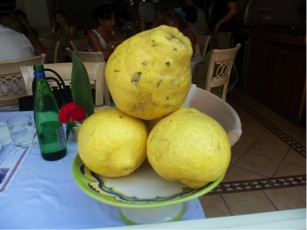
Amalfi Coast Lemons - they grow to be the size of grapefruits!

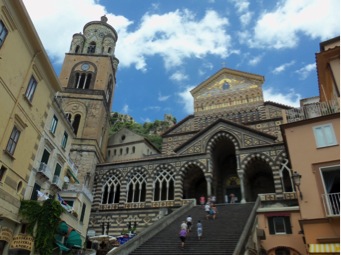
The famous Duomo of San Andrea on the Piazza of Amalfi

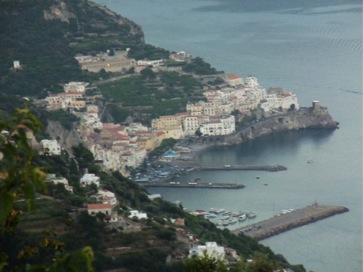
View of Amalfi from a town above called Tovere

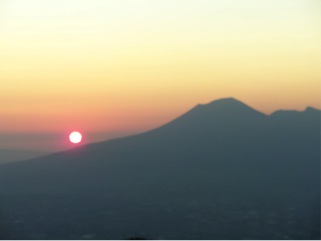
Sunset over Mount Vesuvius. I snapped this picture on a drive back to Amalfi from Naples. Mount Vesuvius is a volcano that destroyed the ancient city of Pompeii in 79 AD.